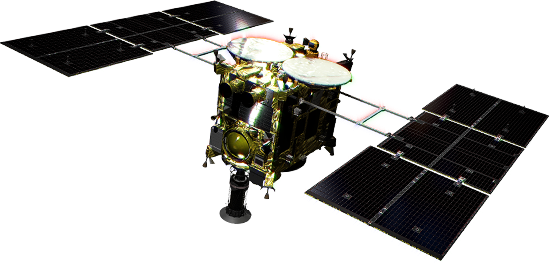
It was confirmed on June 9th that the ion engine operations were successfully completed on June 6, 2026, at 16:33:29 UT (June 7, 01:33:29 JST). Since the return of the re-entry capsule to Earth in December 2020, Hayabusa2 project team has been engaged in the extended mission. Throughout the extended mission, among the four ion engines A, B, C, and D, three engines A, C, and D experienced an unexpected rise in neutralizer voltage—an indicator of performance degradation.[1,2] Consequently, ion engine B has been operated alone to realize the asteroid “Torifune” fly-by on July 5th at 6:30p.m. JST.
For the ion engine B, a similar voltage rise began to appear during the ion engine operations that started on April 21, 2026, as shown in Figure 1. As of June 9th, ion engine B has accumulated 8,143 hours of operation, as detailed in Table 1 below. As a whole, the ion engine system has already achieved a total impulse approximately 20% higher than the first-generation spacecraft Hayabusa, with the velocity increment ΔV over 2 km/s. Taking the nominal mission ΔV as 100%, the 155% ofΔV requirement has been achieved up to now. [2] To prevent further increment of the neutralizer voltage, the flow rate of xenon gas supplied to the engine has been increased above the nominal rate. In Figure 1, it can be observed that the neutralizer voltage for B shown as green is rising at a much slower rate compared to A (purple), C (light blue), and D (orange), with respect to operation time.
Following the asteroid flyby, the ion engine team, shown in Figure 2 and 3, will shortly start the operation to realize the Earth swing-by scheduled in December 2027.
References
1. https://www.hayabusa2.jaxa.jp/topics/20221223_IES/
2. https://www.hayabusa2.jaxa.jp/news/20241225_extended

Following operation in the “+3mA mode,” engines A, C, and D were switched to
“NEUT_OFF mode,” which set the neutralizer potential to the floating potential."


Ryudo Tsukizaki, Ph.D
Ion engine team lead
June 11th, 2026