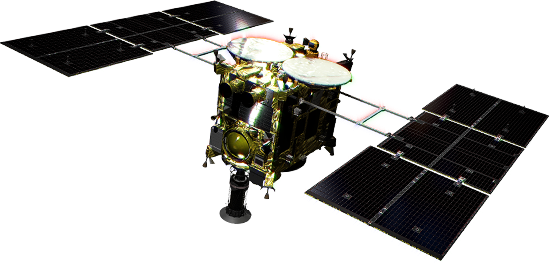
On 5 July 2026, Hayabusa2 will conduct a flyby observation of the asteroid Torifune. The spacecraft is currently approaching Torifune, and we have now successfully detected the asteroid from Hayabusa2 for the first time (Figure 1).

Figure 1: Image of Asteroid Torifune captured by Hayabusa2. This image is a composite of photographs taken at intervals between 20 June and 21 June 2026. The small celestial body within the yellow square is Torifune, moving in the direction of the arrow. The image is a cropped section of approximately one square degree, created from images captured by the Optical Navigation Camera - Telescopic (ONC-T) with a scale of approximately 22.3 arcseconds per pixel. (© JAXA, Chiba Institute of Technology, Japan Spaceguard Association.)
Figure 1 is a composite image created by overlaying several images taken between 20 June 2026 at approximately 03:00 JST and 21 June 2026 at approximately 19:00 JST. The images were captured using Hayabusa2’s onboard Optical Navigation Camera - Telescopic (ONC-T). Torifune was observed moving in the direction indicated by the yellow arrow. The exposure time for each image was approximately 178 seconds, and Torifune has a brightness of about magnitude 12.5. Torifune appears in the direction of the constellation Libra as seen from Hayabusa2. The distance from the spacecraft is approximately 7 million km. (Figure 2 shows the original image, and Figure 3 shows a video.)

Figure 2: Asteroid Torifune images by Hayabusa2. This is the source image for Figure 1. (© JAXA, Chiba Institute of Technology, Japan Spaceguard Association.)

Figure 3: A video created from images of asteroid Torifune captured by Hayabusa2. (© JAXA, Chiba Institute of Technology, Japan Spaceguard Association.)
Asteroid Torifune was observed in the anticipated direction. This confirms that Hayabusa2 is correctly headed towards Torifune. The team were relieved to see that Hayabusa2’s trajectory is not significantly off course! In practice, the orbital operations of Hayabusa2 were carried out with great precision.
In Figure 1, the image size of Torifune is less than one pixel. Hayabsua2 will continue to image the asteroid while approaching. This is an “optical-radio hybrid navigation” method that was also used during the approach to asteroid Ryugu, but this time the approach velocity is very different. During the rendezvous with asteroid Ryugu, the final relative velocity (the velocity compared to that of Ryugu) was ultimately only a few centimeters per second. However, the relative velocity during the Torifune flyby is 5 km/s. We will therefore need to proceed by utilizing a new method of navigation guidance.
When will we be able to see the real appearance of Torifune? Torifune’s shape should begin to become visible one minute before the time of closest approach. Until then, the asteroid can only be imaged at about a single pixel. The appearance of Torifune will therefore only be confirmed after the flyby.
The real challenge now begins! How to bring Hayabusa2 into close proximity to Torifune with the utmost precision is our next challenge.
Hayabusa2# Extended Mission Team
2026.6.24